
 Post by
 If you were recovering in a hospital…
Or sending your child to school…
Would you expect meals that support health—or quietly increase the risk of disease?
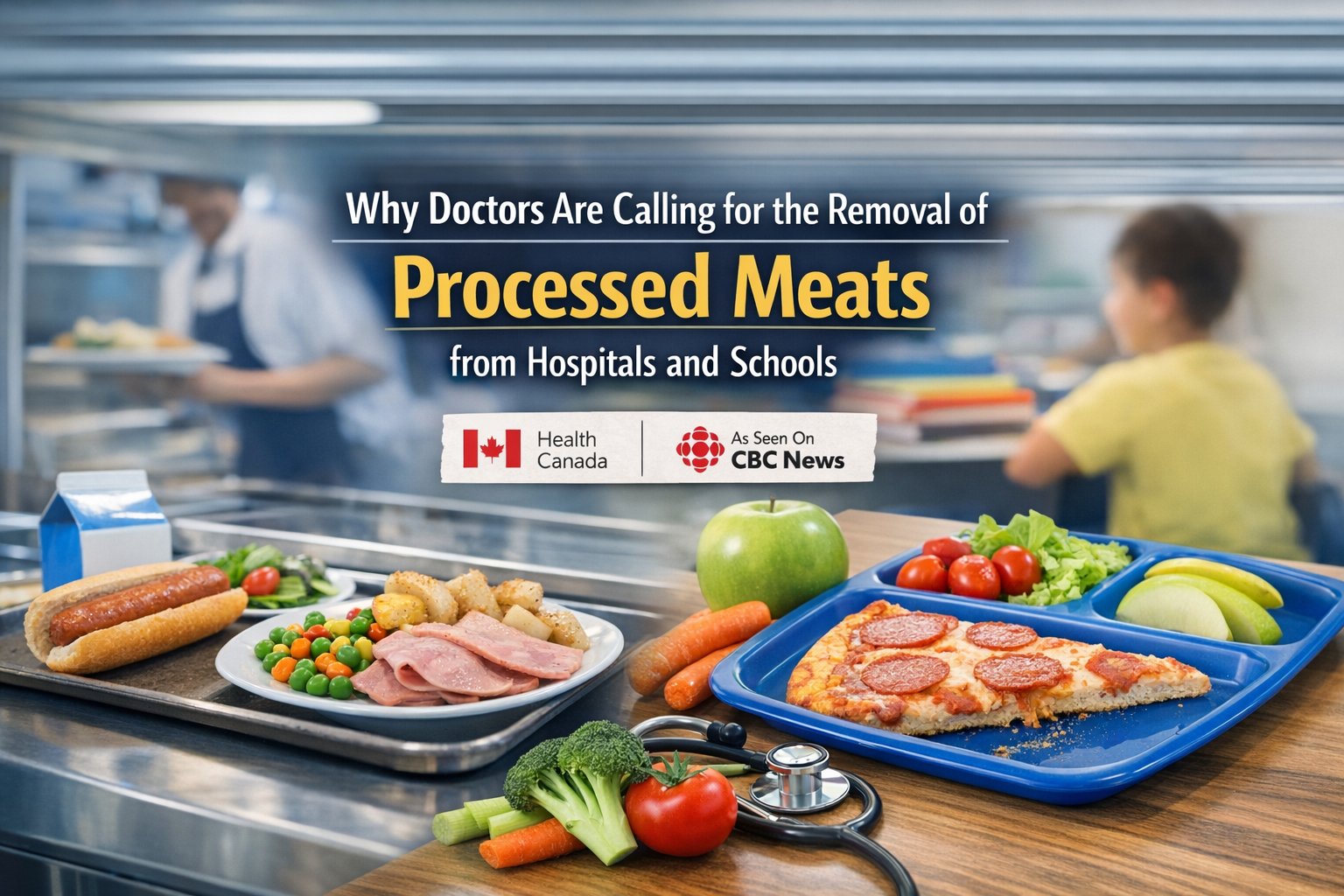
This question is at the heart of a national open letter, both Arjun and I were proud to sign alongside hundreds of Canadian physicians, dietitians, nurses, and allied health professionals. Together, we formally called on Health Canada, the Federal Minister of Health, and Provincial Ministers of Health and Education to remove processed meats from hospital and school menus across Canada.
The letter was submitted on January 19, 2026, and the issue has since gained national attention through press releases and media coverage, including CBC News.
Here’s why this matters—deeply.
As physicians, we often meet people at the most vulnerable moments of their lives—when illness has disrupted normalcy, when children are forming lifelong habits, and when families are relying on our healthcare systems to model health, not undermine it.
What’s the Problem with Processed Meat?
Processed meats include foods like hot dogs, bacon, sausages, ham, and deli meats.
These aren’t controversial foods from a scientific standpoint.
They are classified as Group 1 carcinogens, meaning there is clear evidence they cause cancer in humans. In fact:
- Just 50 grams per day—about one hot dog or two slices of bacon—increases colorectal cancer risk by 18%
- An estimated 5,000 cancer cases each year in Canada are linked to processed meat consumption
Colorectal cancer is now rising in younger adults, and cancer overall remains the leading cause of premature death in Canada.
Beyond cancer, higher intake of processed and red meats is linked to:
- Heart disease and stroke
- Type 2 diabetes
- High blood pressure
- Earlier death
These are the very conditions filling our hospitals and shortening lives.
What Specifically in Processed Meat Causes Cancer?
Processed meats are linked to cancer—especially colorectal cancer because of specific chemicals formed during processing and cooking, and how they interact with your cells and gut. Here’s the clear breakdown.
The main cancer-causing culprits
1. Nitrites & nitrates → N-nitroso compounds (NOCs)
- Added to processed meats to preserve color, prevent bacterial growth, and extend shelf life
- In the body (especially the gut), nitrites react with proteins (amines) to form N-nitroso compounds
- NOCs directly damage DNA, increasing mutation risk
- The colon is especially exposed because this reaction happens inside the digestive tract
👉 This is one of the strongest mechanisms linking processed meat to colorectal cancer.
2. Heme iron (abundant in red & processed meat)
- The iron that gives meat its red color
- Promotes formation of carcinogenic N-nitroso compounds
- Causes oxidative stress that injures intestinal cells
- Also alters the gut environment in ways that promote tumor growth
📌 This is why processed red meats are particularly concerning.
3. High-temperature cooking byproducts
When processed meats are grilled, fried, or smoked, they produce:
a) Heterocyclic amines (HCAs)
- Form when meat proteins react at high heat
- Known to be mutagenic (cause DNA mutations)
b) Polycyclic aromatic hydrocarbons (PAHs)
- Form when fat drips onto flames or during smoking
- Carcinogenic compounds that bind directly to DNA
4. Smoking & curing chemicals
- Traditional curing and smoking introduces additional toxic compounds
- These can compound the effects of nitrites and high-heat cooking
Important nuance
- This does not mean “one hot dog causes cancer”
- Risk increases with frequency and cumulative exposure
- Diets high in fiber, antioxidants, and plant foods can reduce some of the damage—but do not eliminate the risk
Bottom line
Processed meat causes cancer primarily because it:
- Introduces nitrites/nitrates → carcinogenic N-nitroso compounds
- Contains heme iron that promotes oxidative damage
- Produces DNA-damaging chemicals when cooked or smoked
If the Evidence Is Clear, Why Hasn’t Action Followed?
In 2015, the World Health Organization classified processed meat as a Group 1 carcinogen, meaning there is strong evidence it causes cancer in humans.
So why—ten years later—are processed meats still served in hospitals and schools?
Because science often moves faster than policy.
What History Teaches Us
We’ve seen this delay before.
The link between smoking and cancer was clear by the 1950s. Yet smoking remained allowed in hospitals, airplanes, and public spaces for decades. In Canada, bans in hospitals and public places did not occur until the 1990s and early 2000s—nearly 40 years after the evidence was established.
The science didn’t change.
Policy eventually did.
Processed Meat Is Following a Similar Trajectory
Processed meat has long been:
normalized in institutional settings
marketed as convenient and affordable
culturally embedded in menus
perceived as “protein” rather than as a risk factor
As a result, policy has lagged behind evidence.
Just as it once felt unthinkable to ban smoking in hospitals, it may now feel uncomfortable to question what’s served on hospital and school trays. But history shows us this discomfort is often a signal that change is overdue.
Evidence First, Action Next
When we removed smoking from hospitals, it wasn’t about restricting choice—it was about protecting health in places meant to heal.
The same principle applies here.
Removing processed meats from hospitals and schools does not ban them everywhere. It simply acknowledges that publicly funded health and education settings should align with what we know prevents disease.
Science doesn’t create change on its own.
People do.
And just as it took courageous voices to reframe smoking as a public health issue—not a personal preference—it will take collective advocacy to bring institutional food policies in line with modern evidence.
Action often comes decades after certainty.
This open letter is one step in that direction.
The Cost We’re All Paying
Diet-related diseases don’t just affect individuals. They strain all of us.
Every year in Canada:
- Billions of dollars are spent on cancer, diabetes, and heart disease care
- Healthcare wait times grow longer
- Health professionals face increasing burnout
- Families bear the physical, emotional, and financial burden
Much of this is preventable.
Canada’s own Food Guide encourages eating more plant-based foods and limiting processed meat. Continuing to serve it in publicly funded institutions quietly undermines that guidance—especially for people who trust these environments to protect their health.
A Simple, Evidence-Based Solution
In our open letter, we proposed three practical steps:
- Phase out processed meats from hospital and school menus
- Align institutional food standards with current health evidence
- Educate the public about healthier, affordable alternatives
This is not about perfection.
It’s about aligning our food environments with what we already know saves lives.
Why We Added Our Voice as Physicians
As a doctor, I see the downstream effects of food policy every single day—long after the choices were made, when the damage is already done.
Advocacy is part of healthcare.
When the evidence is clear, and the solution is achievable, speaking up is not political—it’s ethical.
Both Arjun and I joined this letter because hospitals and schools should model health, not quietly contribute to disease. Removing processed meats from these settings is a small change with enormous potential impact—for our children, our patients, and our healthcare system.
Moving Forward
This letter is not the end of the conversation—it’s the beginning.
Food policy shapes health long before anyone becomes a patient. When we improve what’s served in our most trusted public institutions, we protect not just today’s health—but the future.
If hospitals are places of healing, and schools are places of growth, then the food served there should reflect that truth.
Media Coverage
Here are some of the links to media coverage
https://www.cbc.ca/player/play/video/9.7051689
Canadian Health Professionals Call for Institutional Ban on Processed Meats
Docs, dietitians urge schools, hospitals to take processed meat off menu
Health professionals call for removal of processed meats from hospitals, schools
The Full Open Letter
For transparency and accountability, I am sharing the entire open letter here as it was submitted, including references and the full list of signatories.
We offer these recommendations in a spirit of collaboration and shared purpose and stand ready to support leaders in creating healthier, more sustainable food environments for all Canadians.
In Health,
Drs. Arjun & Shobha Rayapudi



0 comment
LEAVE A REPLY HERE
Your email address will not be published.