
When Relationships Stress You Out: Remember These 4 Choices
What is one of the biggest sources of stress in our lives?
Other people.
Not necessarily because people are difficult or intentionally hurtful.
So much of stress comes from one simple fact: we can’t control other people.
We can’t control what they say, what they do, or how they respond to us.
Yet we spend so much of our energy trying to change them.
We want our partner to understand us.
We want our children to listen.
We want our parents to change.
We want our friends to show up differently.
We want our colleagues to behave differently.
And when they don’t, we feel frustrated, disappointed, angry, or hurt.
But what if the real skill isn’t learning how to change other people?
What if it is learning how to manage ourselves in relationships?
Maybe That’s Why We Have Families
It teaches us how to love people we don’t always like or hate sometimes 🙂
Relationships aren’t meant to teach us how to control people.
They teach us how to love, communicate, set boundaries, accept differences, and manage our own minds.
Relationship is a skill.
You Have to Become Skilled in Relationships
In any relationship, we are there to care, share, and contribute to each other’s happiness.
In any relationship, we need to be happy within ourselves most of the time.
People can add to your happiness, but they cannot be responsible for it.
This is the biggest blunder we make when we start expecting our happiness to come from the other person.
“You should understand me.”
“I need you to give me more attention.”
“You should respect me.”
“You should reassure me.”
“You should make me feel loved.”
The more we depend on someone else’s mood or behavior for our happiness, the more power we give away.
This doesn’t mean the other person doesn’t love or care about us.
They may simply be caught up in their own stress, struggles, fears, or thoughts.
And when someone is struggling to manage their own mind, how can we expect them to consistently give us the care, patience, and reassurance we want?
Caring and sharing come from within. That comes when someone has wisdom, when there is inner quietness and less stress.
When that is not there, people need space.
Sometimes they need time.
Sometimes they are simply having a difficult day.
The moment we start demanding, “You should be doing this. You should be saying that. You need to give me this,” we can create even more tension in the relationship.
Ultimately, we can’t control their mood, their words, or their behaviour. But we can choose how much space we let them take up in our mind and how much we allow their actions to stress us.
Think about how much time and energy we spend thinking,
“Why did they say that?
Why are they acting this way?
Why can’t they change?”
When we stop giving so much of our energy to things we cannot control, we get that energy back.
And we can use it on the person we actually can change—ourselves.
When we start protecting our time and energy from everything happening around us, we begin to realize just how much energy we actually have.
Instead of using it to worry about other people, we can use it to focus on ourselves—our health, our happiness, our growth, and the things that truly matter to us.
You can’t control other people. But you can choose where your time, energy, and attention go.
One of the biggest misconceptions we have about love is:
“If I love this person enough, I can change them.”
But people change when they are ready to change—not when we decide they should.
Love is not about turning someone into the person we want them to be.
Sometimes, love is learning to see people as they are—and accepting that they may not be who we wish they were.
That doesn’t mean accepting abuse, disrespect, or harmful behavior. We can still set boundaries and decide what we will and will not accept.
But we cannot control another person’s mind.
Are You Caught in the Complaining Spiral?
Complaining can actually feel good in the moment.
We vent.
Someone listens.
We feel understood.
For a few minutes, the pressure comes down.
But there is a problem:
When we keep complaining about something we cannot control, we can keep ourselves stuck in the very situation we are complaining about.
The first step is simply to notice it.
“I am complaining about this again.”
That awareness is powerful.
Then ask yourself:
What can I actually do about this?
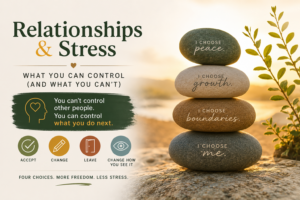
In almost any difficult situation, you essentially have four choices.
The Four Choices
1. Accept it
Some things cannot be changed.
Acceptance doesn’t mean you like the situation.
It means you stop fighting reality.
You say:
“This is the situation I am dealing with right now.”
And from there, you decide what comes next.
2. Change it
If something can be changed or improved, take action.
Have the conversation.
Ask for what you need.
Set a boundary.
Change your behavior.
Do something different.
3. Leave it
Sometimes the healthiest choice is to walk away.
Not every relationship, environment, conversation, or situation needs to be endured forever.
Leaving can be an act of self-respect.
4. Change how you see it
Sometimes the situation cannot change—but your relationship with the situation can.
You can change the way you look at it.
You can change the meaning you give it.
You can ask:
“What can this teach me?”
“What is within my control?”
“How do I want to respond?”
This is where emotional freedom begins.
Stop Saying “Should.” Start Asking “Could.”
There is another small change in language that can make a big difference.
“Should” creates pressure.
Think about how you feel when someone tells you:
“You should do this.”
Even if they mean well, something inside us may immediately resist:
“Don’t tell me what to do.”
This is called reactance—our natural resistance when we feel someone is taking away our freedom to choose.
And we do the same thing to ourselves.
I should have done that.
I should exercise more.
I should be more patient.
I should have handled that differently.
The word should often brings guilt, pressure, and self-judgment.
Try replacing it with:
“What could I do?”
Notice the difference.
“Could” opens the door to possibilities without forcing us to do anything.
Try the “Could → Will” Exercise
The next time you feel stuck, take a piece of paper and divide it into two columns.
WHAT COULD I DO?
Write down everything you could do.
Maybe you could:
- Have an honest conversation
- Set a boundary
- Take some space
- Stop engaging in the argument
- Ask for help
- Change your expectations
- Look at the situation differently
- Accept what you cannot change
- Walk away
- Do nothing for now
Don’t judge the ideas.
Just create possibilities.
Then move to the second column:
WHAT WILL I DO?
Choose one, two, or three things that are actually within your control.
Then take the step.
This simple exercise does something powerful:
It brings your sense of control back to you.
Instead of remaining stuck in:
“Why are they doing this?”
you begin asking:
“What can I do?”
And that is a completely different place to live from.
Relationships Don’t Have to Be Perfect
Healthy relationships aren’t relationships without conflict.
They are relationships where we learn how to handle conflict with greater awareness.
We learn when to speak.
When to listen.
When to set a boundary.
When to give space.
When to let go.
When to accept.
And when to change ourselves.
The goal isn’t to control everyone around us.
The goal is to become so skilled at managing ourselves that other people’s behavior doesn’t constantly control our inner state.
Because ultimately:
You cannot control what someone else says.
You cannot control what they think.
You cannot control whether they change.
But you can control what you do next.
You can accept.
You can change.
You can leave.
Or you can change how you see it.
Four choices.
And sometimes, simply knowing that you have a choice is enough to turn a stressful situation into an opportunity for greater wisdom, freedom, and peace.
The next time someone is stressing you out, pause before asking:
“How do I get them to change?”
Instead ask:
“Which of my four choices is available to me right now?”
That is where your power begins.
Search Blogs
